
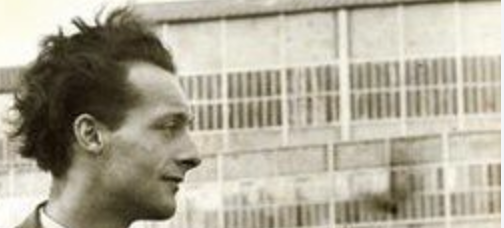
Maurice Merleau-Ponty (1908–1961) spent his career arguing for something that sounds obvious until you try to think it through: we do not look out at the world from behind our eyes. We are in it, bodily, before we ever form an opinion about it. Of the great phenomenologists he is the one who took the body seriously — not as the machine the mind rides in, but as the very thing that opens a world in the first place.
Neither Sensation Nor Judgment
In Phenomenology of Perception (1945), Merleau-Ponty set himself against the two explanations of perception then on offer. Empiricism said the mind assembles experience from raw atoms of sensation. Intellectualism said the mind imposes order through judgment. He rejected both, and for the same reason: each starts with a world already divided into a thinking subject and an object to be known, then tries to glue the two back together.
What he described instead was prior to that split. Before any judgment is made, the situation already has a shape. The cup already appears as graspable, the stair as climbable, the face across the table as friendly or closed. Meaning is not added to perception afterwards. It arrives with it.
The Lived Body
Merleau-Ponty distinguished the body as object — the one a physician examines — from the lived body, the body as we inhabit it from the inside. You do not locate your hand by looking for it. You know where it is the way you know a sentence you are in the middle of saying. He called this the body schema: a working, pre-reflective sense of one's own posture and reach that organizes everything appearing around it.
From this follows his central claim, that the body is our general medium for having a world. Change the body and the world changes with it. The blind man's cane, once practiced, stops being a tool held at arm's length and becomes an extension of touch; the world simply begins further out. Perception is not a picture received. It is a relationship maintained.
The Flesh
In his unfinished late work, published after his sudden death at fifty-three as The Visible and the Invisible (1964), Merleau-Ponty reached for a term to name what perceiver and perceived have in common. He called it the flesh — not matter and not mind, but the shared fabric that allows one part of the world to be sensitive to the rest of it. His favorite example was the hand that touches the other hand: at any moment one is touching and one is touched, and the roles reverse without warning. We are of the same stuff as what we perceive, and that is the condition of perceiving it at all.
Why He Still Matters Here
Experience Organization rests on the observation that lived experience is organized through the Soma and extended into a surround of sensory representation. Merleau-Ponty is the philosopher who made that case most rigorously, and made it half a century before the cognitive sciences came around to it. Read him now and the embodied-cognition literature of the last thirty years reads like a long empirical footnote.
For the practitioner, the usable part is his insistence that the organizing happens before we notice it. By the time a situation has become describable, it has already been shaped — by posture, by breath, by habit, by where attention settled. That shaping is exactly what careful attention can recover.
Books by Maurice Merleau-Ponty
The Structure of Behavior (1942)
Phenomenology of Perception (1945)
Humanism and Terror (1947)
Sense and Non-Sense (1948)
Adventures of the Dialectic (1955)
Signs (1960)
Eye and Mind (1961)
The Visible and the Invisible (1964, posthumous)
The Prose of the World (1969, posthumous)