
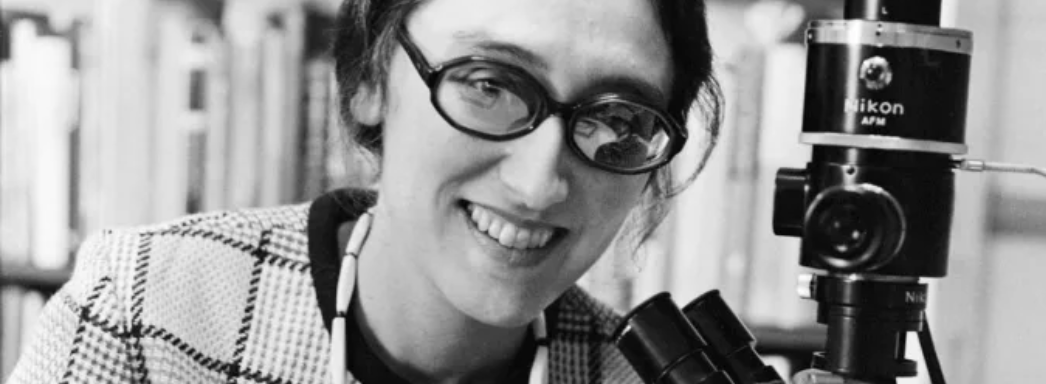
In 1966 a young biologist named Lynn Sagan submitted a paper arguing that the complex cell — the kind that makes up every plant, animal and fungus on Earth — did not evolve gradually from simpler cells at all. It was assembled, she said, out of separate bacteria that had taken up residence inside one another and stayed. The paper was turned down by roughly fifteen journals before the Journal of Theoretical Biology published it in 1967 as "On the Origin of Mitosing Cells." Under her later name, Lynn Margulis (1938–2011), the author went on to see that idea move from heresy to the opening chapter of the textbooks.
The Evidence Was Hiding in Plain Sight
The claim was testable, which is why it won. If mitochondria — the structures that supply nearly all of a complex cell's energy — were once free-living bacteria, they should carry traces of their independence. They do. Mitochondria have their own DNA, circular like a bacterium's rather than packaged like ours. They have their own ribosomes, which resemble bacterial ribosomes closely enough that some antibiotics affect them. They are bounded by a double membrane, as expected of something engulfed rather than grown. And they do not get built from instructions in the nucleus; they divide on their own schedule.
The same holds for chloroplasts, the structures that make photosynthesis possible in plants, which trace back to free-living cyanobacteria. Every breath taken on this planet depends on a partnership struck roughly a billion and a half years ago and never dissolved.
Symbiogenesis
Margulis gave the general principle a name borrowed from earlier Russian work: symbiogenesis, the origin of new forms through the merger of existing ones. Her argument was not that natural selection is wrong. It was that selection explains how variations spread, while saying little about where genuinely new kinds of organism come from — and that the major transitions in evolutionary history came from organisms joining, not merely from accumulated mutation.
This put her at odds with much of her field for decades. The prevailing picture emphasized competition between individuals and between genes; hers emphasized the acquisition of whole genomes and the permanence of partnership. "Life did not take over the globe by combat," she wrote, "but by networking." She worked with James Lovelock on the Gaia hypothesis for the same reason, supplying the microbiology for the proposal that the planet's chemistry is regulated by the life living in it.
She received the National Medal of Science in 1999. She also remained a dissenter to the end on several questions well outside her expertise, and not all of those positions held up; the symbiotic account of the cell is the one that was tested and won, and it is the one that matters.
A Different Shape of Explanation
What makes Margulis more than a specialist's hero is the form her explanation takes. The standard story of complexity is incremental — small changes, filtered over long time. Hers is compositional: two complete, already-working wholes come together and produce something neither was, with capacities neither had. The result cannot be read off from either partner. It has to be understood at the level of the association.
Why She Still Matters Here
Experience Organization names symbiogenesis among its sources, alongside morphic resonance and autopoietic theory, as evidence that living systems are cooperative and self-replicating rather than merely competitive. The relevance is structural. If the most consequential innovation in the history of life came from organisms organizing with each other, then co-creation is not a soft metaphor imported into biology from the therapy room. It is how the cell doing the reading was built.
Books by Lynn Margulis
Origin of Eukaryotic Cells (1970)
Symbiosis in Cell Evolution (1981)
Five Kingdoms: An Illustrated Guide to the Phyla of Life on Earth (1982, with Karlene Schwartz)
Microcosmos: Four Billion Years of Microbial Evolution (1986, with Dorion Sagan)
What Is Life? (1995, with Dorion Sagan)
Symbiotic Planet: A New Look at Evolution (1998)
Acquiring Genomes: A Theory of the Origins of Species (2002, with Dorion Sagan)