
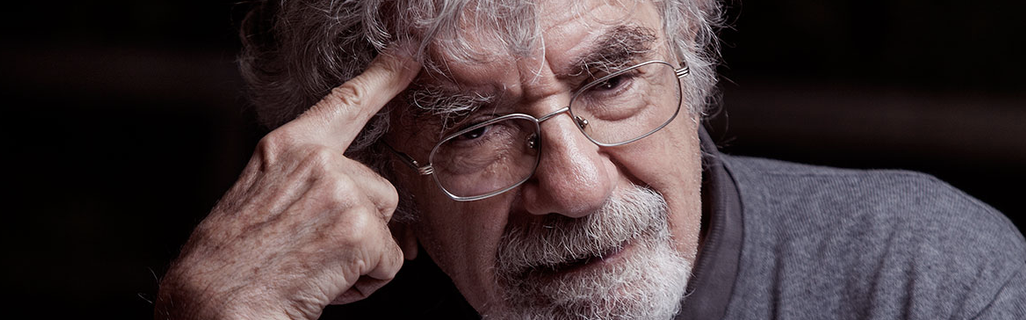
Humberto Maturana (1928–2021) asked a question most biologists had learned to step around: what is it, exactly, that makes a living system living? Not which features it displays — metabolism, reproduction, response to stimuli — but what it is doing such that those features follow. The Chilean biologist spent fifty years on the answer, and the word he and Francisco Varela coined for it has since traveled far beyond biology.
What the Frog's Eye Told Him
Maturana's path began in the laboratory. As a young researcher at MIT he was a co-author of "What the Frog's Eye Tells the Frog's Brain" (1959), a celebrated paper showing that a frog's retina does not transmit a faithful image to the brain. It transmits a handful of highly specific detections — small dark moving objects, sudden dimming — selected by the structure of the eye itself.
The intended conclusion was about visual processing. The conclusion Maturana drew was larger and more unsettling. If the nervous system responds according to its own structure rather than to the properties of an external stimulus, then perception cannot be the pick-up of information from a pre-given world. The organism does not receive a world. It brings forth the only world it can have, given how it is built.
Autopoiesis
The answer to his original question, worked out with Varela in Santiago in the early 1970s, was autopoiesis — self-production. A living system is a network of processes that continuously produces the very components that constitute the network, and in doing so specifies its own boundary. A cell makes the membrane that makes the cell possible.
What distinguishes this from a machine is the relation between product and organization. A car factory produces cars; it does not produce itself. A cell produces nothing but its own continued production. On this definition, life is not a list of properties but a particular closed organization — and the definition is sharp enough to test.
Maturana drew a further distinction that does much of the work in his later writing. The organization of a system is the set of relations that make it what it is; its structure is the particular components realizing those relations at a given moment. A system can change structure continuously while conserving its organization. That is precisely what staying alive consists of.
Structural Coupling and the Observer
An autopoietic system is operationally closed but not isolated. It is perturbed by its medium, and over time system and medium change together in a history of mutual accommodation that Maturana called structural coupling. The environment does not instruct the organism; it triggers changes the organism's own structure determines. Two systems that have drifted together for long enough come to fit each other without either having directed the other — a description that applies as readily to a long partnership as to a cell in a tissue.
From this he drew the claim that living is itself cognition: an organism's whole history of viable structural change is what knowing amounts to, with or without a nervous system. And his most quoted sentence — "everything said is said by an observer" — follows from the same root. There is no description from nowhere. Every account arises from a particular observer with a particular structure, a point he insisted on long enough to be thought tiresome, and which has aged very well.
Why He Still Matters Here
Experience Organization names autopoietic theory among its sources, and the reason is not decorative. Maturana supplies a biologically grounded account of the capacity EO works with directly: that a living system organizes itself, that it does so continuously, that its structure determines what the world can be for it, and that two systems in sustained contact shape one another's organization without either controlling it. The way a person's experience becomes habitual — and co-created with the people around them — is structural coupling observed from the inside.
Books by Humberto Maturana
Biology of Cognition (1970)
Autopoiesis and Cognition: The Realization of the Living (1980, with Francisco Varela)
The Tree of Knowledge: The Biological Roots of Human Understanding (1987, with Francisco Varela)
The Origin of Humanness in the Biology of Love (2008, with Gerda Verden-Zöller)