
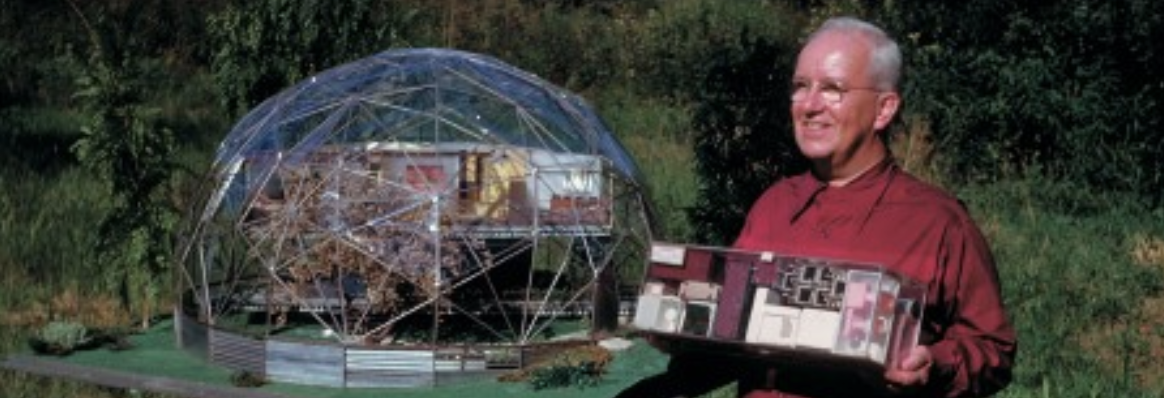
Buckminster Fuller (1895–1983) left behind geodesic domes, a three-wheeled car, a map of the Earth with almost no distortion, and a word that has since been worn smooth by overuse. The word is synergy, and in Fuller's hands it was not a motivational slogan. It was a precise claim about how wholes behave, and it is the reason he belongs in this series.
The Experiment
Little in his early life suggested what followed. He was expelled from Harvard twice. A business venture failed. In 1927, in Chicago, at the lowest point of a bad year, he arrived at a decision he described ever afterwards as the hinge of his life: rather than end it, he would conduct an experiment to find what, if anything, a single individual could do on behalf of humanity that large institutions could not or would not. He referred to the subject of the experiment as Guinea Pig B and kept it running for fifty-six years, documenting it in a chronicle that grew to an estimated several hundred thousand pages.
The output was prolific and uneven: the Dymaxion house, the Dymaxion car, the Dymaxion map, the geodesic dome patented in 1954 and built thousands of times over, including the great sphere at Expo 67 in Montreal. Twenty-eight patents, dozens of honorary degrees, and the Presidential Medal of Freedom in 1983.
Synergy, Defined Properly
Fuller's definition is worth quoting exactly, because the precision is the point: synergy is the behavior of whole systems unpredicted by the behavior of their parts taken separately.
Note what it does not say. It does not say the whole is greater than the sum of its parts, which invites the question of what units the greatness is measured in. It says the whole behaves in ways you could not have predicted from the parts, however thoroughly you studied them one at a time. Chrome-nickel steel holds at temperatures far beyond what any of its constituent metals can withstand alone, and no amount of analysis of chromium will tell you so. The tensile strength belongs to the alloy.
His generalization was blunt and, so far, unrefuted: there is nothing in the chemistry of a toenail that predicts the existence of a human being.
Synergetics
From this he built the system set out in Synergetics: Explorations in the Geometry of Thinking (1975) and its sequel. His conviction was that nature does not compute in the ninety-degree grid our mathematics inherited; it builds in tetrahedra and in closest-packed spheres, and a geometry that started there would describe structure more economically. The two volumes are idiosyncratic, demanding, and still being mined.
Two further coinages came from the same work. Tensegrity — tensional integrity — names the structures, developed with the sculptor Kenneth Snelson, in which isolated compression members float within a continuous net of tension, so that the integrity belongs to the pattern of relationships rather than to any member. Ephemeralization names the long historical trend of doing more with less, the basis of his argument that scarcity is more often a design failure than a physical fact. And Operating Manual for Spaceship Earth (1969) gave the environmental movement a frame it still uses.
Why He Still Matters Here
Experience Organization draws on Systems Theory and Synergetics explicitly, for a reason that becomes clear once Fuller's definition is on the table. EO holds that human experience is not the sum of its individual elements but a fluid series of cohesive wholes that cannot be predicted by their parts alone. That is Fuller's sentence, applied to experience rather than to materials.
The methodological consequence follows directly. If a system's behavior is unpredicted by its parts, then taking it apart to study it destroys the thing being studied. Whole systems have to be observed whole — which is also the first discipline EO asks of a practitioner.
Books by Buckminster Fuller
Nine Chains to the Moon (1938)
No More Secondhand God and Other Writings (1963)
Ideas and Integrities (1963)
Operating Manual for Spaceship Earth (1969)
Utopia or Oblivion: The Prospects for Humanity (1969)
I Seem to Be a Verb (1970)
Synergetics: Explorations in the Geometry of Thinking (1975)
Synergetics 2: Further Explorations in the Geometry of Thinking (1979)
Critical Path (1981)
Grunch of Giants (1983)